

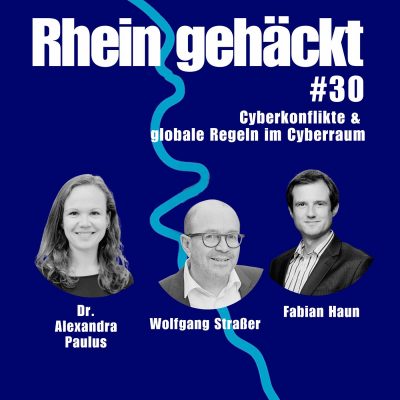
Cyber Conflicts & Global Rules in Cyberspace
(with Dr. Alexandra Paulus of the German Institute for International and Security Affairs)
In this episode of Rheingehäckt, we take a look at current developments in cyber operations in the context of global conflicts—from Russia to the Middle East—and discuss what specific threats Germany might face. We’ll also address vulnerabilities in digital supply chains, the role of state cyber capabilities, and the question of how resilient our systems—including the Bundeswehr—actually are.
Please note: This podcast is available in German language only.
About this episode
Digital Sovereignty or Total Dependence?
Europe’s Risk in Cyberspace.
In the 30th episode of our podcast “R(h)eingehäckt,” we tackle an existential question: How independent is Europe, really, from the tech giants in the U.S.? Together with Dr. Alexandra Paulus, Fabian Haun and Wolfgang Straßer analyze the fragile structures of our digital world.
One thing is indisputable: the massive dependence on U.S. software and cloud services. They warn that this dominance is not merely an economic issue. In times of political crisis, this dependence turns into a powerful tool for blackmail. They view the role of central infrastructures—such as the CVE vulnerability database—as particularly critical, since the U.S. government controls its funding.
But the dangers do not lurk only at the state level. Dr. Paulus highlights the risks in software supply chains, particularly with regard to the German Armed Forces. She points out that often it is not the large institutions that are the weakest link. Instead, attackers use small suppliers or unsecured open-source components as a gateway to penetrate deep into protected systems.
At the same time, Wolfgang Straßer paints a critical picture of current corporate practices. Despite enormous financial losses caused by cyberattacks, many companies still invest too little in basic security measures. According to BSI data, the discrepancy between perceived and actual security is alarming.
As a solution, the guests advocate for a strategic change of course: Europe must stop merely copying U.S. products. Instead, it must promote its own future-oriented technologies, such as quantum computing, in order to gain real bargaining power. They also call for software manufacturers to embed security right from the development stage. Policymakers, for their part, must finally recognize cybersecurity as a core aspect of national sovereignty.